For the complete documentation index, see llms.txt. Markdown versions of all docs pages are available by appending .md to any docs URL.
Arize Phoenix
Verified : Code examples on this page have been automatically tested and verified.Integrate agentgateway with Arize Phoenix for LLM tracing and evaluation
Arize Phoenix is an open-source LLM observability platform for tracing, evaluation, and debugging.
Features
- LLM tracing - Trace all LLM calls with full context
- Evaluation - Built-in LLM evaluators for quality assessment
- Embedding analysis - Visualize and debug embeddings
- Dataset management - Create and manage evaluation datasets
- Open source - Self-host or use Arize cloud
Quick start
Phoenix 21.0 and later turn on authentication by default, and then reject traces that do not carry an API key. The following local quick start turns authentication off with the PHOENIX_ENABLE_AUTH=false environment variable, so you can try the integration without an API key. For a shared or production Phoenix, keep authentication on and send an API key with your traces.
Run Phoenix locally:
pip install arize-phoenix
PHOENIX_ENABLE_AUTH=false phoenix serve
Or with Docker. Publish port 4317 too, because agentgateway sends traces to Phoenix’s gRPC port.
docker run -e PHOENIX_ENABLE_AUTH=false -p 6006:6006 -p 4317:4317 arizephoenix/phoenix:latestAccess Phoenix at http://localhost:6006.
Configuration
Phoenix accepts OpenTelemetry traces natively on port 4317 (gRPC) and port 6006 (HTTP), so agentgateway can export traces directly to Phoenix without an intermediate OpenTelemetry Collector.
Configure agentgateway to send traces directly to Phoenix.
You can configure tracing in the UI or in your configuration file.
Whether the UI can save depends on your storage mode. For more information, see Save changes from the UI.
Create a configuration that routes LLM traffic, and start agentgateway.
cat <<'EOF' > config.yaml
# yaml-language-server: $schema=https://agentgateway.dev/schema/config
gateways:
  default:
    port: 3000
routes:
- backends:
  - ai:
      name: openai
      provider:
        openAI:
          model: gpt-4o-mini
  policies:
    backendAuth:
      key: "$OPENAI_API_KEY"
EOF
agentgateway -f config.yamlOpen the Settings > Observability page, such as http://localhost:15000/ui/settings/observability, and click the Tracing card.
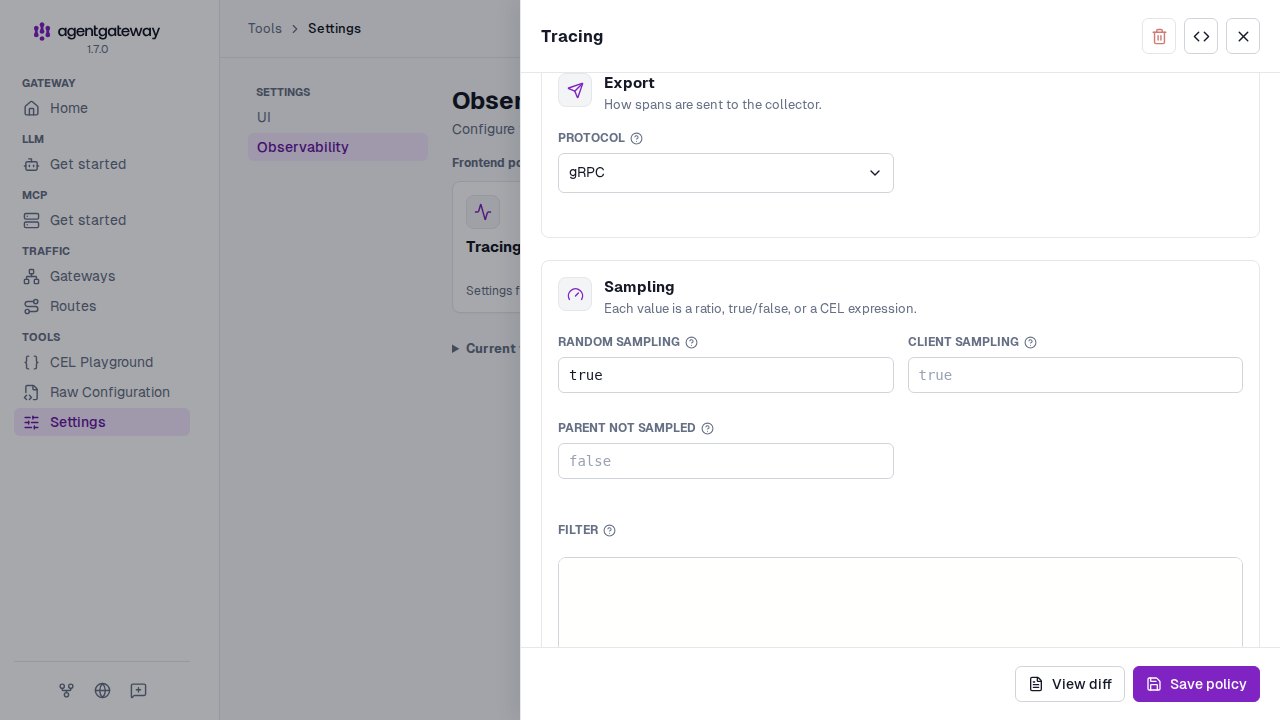
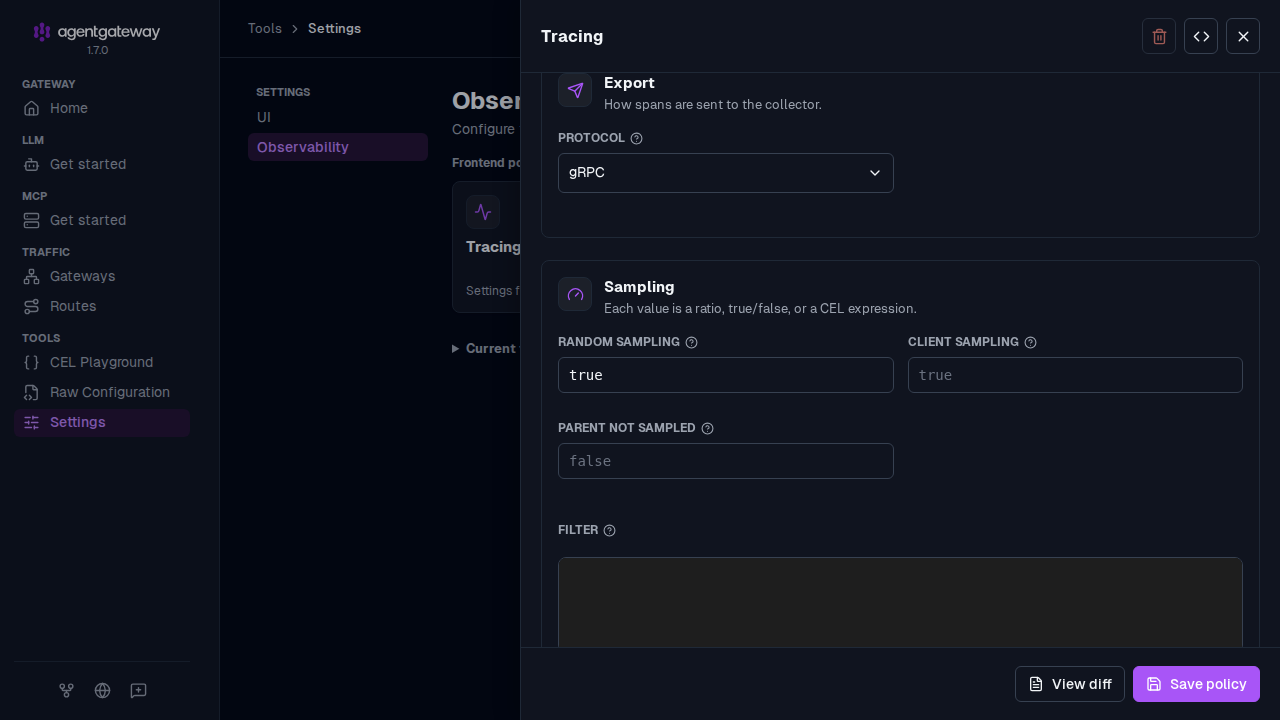
In the Tracing drawer, configure the following fields.
- Host: Keep
localhost:4317. - Protocol: Keep gRPC. The UI does not write the default
protocol: grpcvalue to your configuration. - Random sampling: Enter
true.
- Host: Keep
Click Save policy.
Send traces with an API key
If your Phoenix keeps authentication on, agentgateway must send a Phoenix API key with every trace export. Otherwise, Phoenix rejects the traces.
- Start Phoenix. Authentication is on by default. If the Phoenix instance from the quick start still runs, stop it first, because both instances use ports 6006 and 4317. Phoenix versions earlier than 21.0 also need the
PHOENIX_ENABLE_AUTH=trueandPHOENIX_SECRETenvironment variables.docker run -p 6006:6006 -p 4317:4317 arizephoenix/phoenix:latest - Open Phoenix at http://localhost:6006, and log in as the default admin,
admin@localhostwith the passwordadmin. Phoenix asks you to change the password on first login. - Go to Settings > API Keys, and create a key in the System API Keys section. A system key belongs to Phoenix instead of a user account, so it keeps working if the user who created it leaves.
- Save the key in an environment variable.
export PHOENIX_API_KEY=<your-api-key> - Add the key to the tracing policy with
backendAuth. Agentgateway sends the key in theAuthorization: Bearer <key>header, which is the header that Phoenix checks.# yaml-language-server: $schema=https://agentgateway.dev/schema/config frontendPolicies: tracing: host: localhost:4317 protocol: grpc randomSampling: true policies: backendAuth: key: "$PHOENIX_API_KEY" gateways: default: port: 3000 routes: - backends: - ai: name: openai provider: openAI: model: gpt-4o-mini policies: backendAuth: key: "$OPENAI_API_KEY" - Start agentgateway with the updated configuration, and send a request through it. The trace appears in the
defaultproject in Phoenix. If the key is missing or wrong, Phoenix rejects the export, and the agentgateway logs show aBatchSpanProcessor.ExportErrorerror.
Docker Compose example
Agentgateway exports traces directly to Phoenix without needing an OTel Collector:
version: '3'
services:
  agentgateway:
    image: cr.agentgateway.dev/agentgateway:latest
    ports:
      - "3000:3000"
    volumes:
      - ./config.yaml:/config.yaml:ro
    command: ["-f", "/config.yaml"]

  phoenix:
    image: arizephoenix/phoenix:latest
    environment:
      - PHOENIX_ENABLE_AUTH=false
    ports:
      - "6006:6006"
      - "4317:4317"
When using Docker Compose, update your config.yaml to use the Phoenix service name:
frontendPolicies:
  tracing:
    host: phoenix:4317
    protocol: grpc
    randomSampling: true